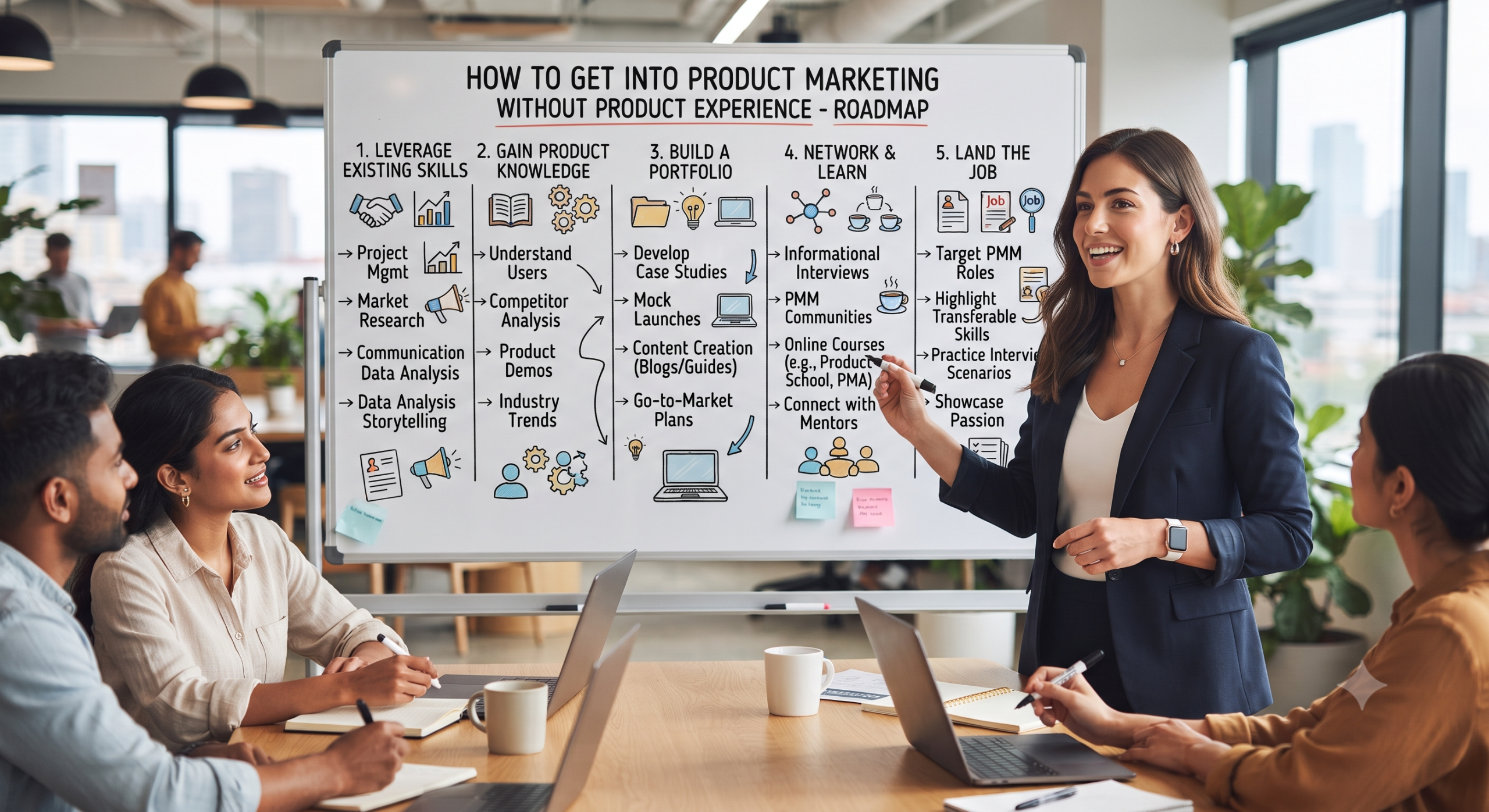
Product marketing connects product development, customer needs, sales, and marketing strategy. As a result, it has become an important career path for professionals who enjoy combining creativity with business strategy. However, many candidates hesitate to enter this field because they do not have direct product marketing experience.
Fortunately, previous experience in marketing, sales, content, customer success, research, or communications can provide a strong foundation. In fact, many product marketing skills are transferable from other business functions. Therefore, the goal is not to completely start over. Instead, you need to understand product marketing, develop relevant skills, and demonstrate your ability through practical work.
This guide explains how to build product marketing experience, create a strong portfolio, improve your resume, and plan a practical career transition.
Understand What Product Marketing Involves
First, understand what product marketers actually do. Product marketing is broader than advertising or content creation. Instead, it focuses on understanding customers and communicating why a product solves a specific problem.
Product marketers commonly work on:
- Customer and market research
- Competitor analysis
- Product positioning
- Messaging strategy
- Product launches
- Sales enablement
- Customer feedback
- Go-to-market planning
- Market analysis
- Product adoption strategies
For example, a product marketer may research why customers choose one software platform over another. Then, they may use that information to develop positioning and messaging for a new campaign.
Similarly, product marketers often work closely with product managers and sales teams. Therefore, communication and cross-functional collaboration are essential skills.
If you have worked in marketing, sales, customer service, research, or content, you may already have some of these capabilities. The next step is to identify them clearly.
Identify Your Transferable Skills
You do not need to begin your career from zero simply because your previous job did not have a product marketing title. Instead, examine your current experience and identify skills that overlap with product marketing.
For example, content marketers often understand customer pain points and audience behavior. Similarly, sales professionals understand customer objections and purchasing decisions. Customer success professionals, meanwhile, often understand product adoption challenges directly from users.
Create a simple list of your existing skills, such as:
- Customer research
- Content strategy
- Market research
- Competitive analysis
- Copywriting
- Sales communication
- Data analysis
- Campaign planning
- Project management
- Presentation
- Customer communication
Next, connect each skill to a real example from your previous work.
For instance, instead of simply writing “strong communication skills” on your resume, explain how you used communication to coordinate a project, solve a customer problem, or explain a complex service.
As a result, your experience becomes more relevant to product marketing roles.
Moreover, this approach helps recruiters understand that you already possess useful capabilities, even if your previous job title was different.
Build Product Marketing Experience Through Projects
If your current position does not provide product marketing opportunities, create your own practical projects. This is one of the most effective ways to demonstrate your ability.
For example, choose a software product, mobile application, financial platform, productivity tool, or consumer service. Then, analyze the product as if you were part of its marketing team.
Your project could include:
- Target audience analysis
- Customer pain points
- Competitor research
- Product positioning
- Key value propositions
- Messaging framework
- Go-to-market strategy
- Launch channels
- Sales enablement ideas
- Performance metrics
For instance, you could select a project management application and identify its primary customer segment. Next, compare it with three competitors. Then, develop a positioning statement explaining why the target customer should consider the product.
Furthermore, you can create a short product launch plan. Include the audience, message, marketing channels, content strategy, and metrics you would track.
These projects provide tangible evidence of your thinking. Therefore, they can be particularly useful when you lack direct product marketing experience.
Learn Positioning and Go-to-Market Strategy
Next, focus on two core product marketing concepts: positioning and go-to-market strategy.
Positioning explains how a product should be understood by a specific audience. In other words, it answers an important question: why should a customer choose this product instead of another option?
For example:
Feature: Automated reporting
Customer benefit: Reduces manual reporting work and saves time.
Feature: Real-time collaboration
Customer benefit: Helps distributed teams coordinate projects more efficiently.
Therefore, practice turning product features into clear customer benefits.
At the same time, learn the fundamentals of go-to-market strategy. A basic framework includes:
- Define the target customer.
- Identify the customer problem.
- Research competitors.
- Establish product positioning.
- Develop core messaging.
- Select marketing channels.
- Coordinate sales and marketing.
- Define launch objectives.
- Track performance.
- Collect customer feedback.
Moreover, study how real companies launch products. Analyze their messaging, target audience, channels, and customer value proposition. This exercise can help you understand how theoretical concepts work in real business situations.
Gain Experience by Working With Product and Sales Teams
If you already work for a company, look for opportunities to collaborate with product or sales teams. You do not necessarily need to change departments immediately.
Instead, volunteer for projects involving:
- Product launches
- Feature announcements
- Customer research
- Competitive analysis
- Sales presentations
- Product documentation
- Customer onboarding
- Webinar campaigns
- Product feedback
- Customer education
For example, if your company is launching a new feature, offer to help create the launch communication. Similarly, if sales representatives repeatedly receive the same customer objections, analyze those objections and suggest new sales materials.
As a result, you can gain practical experience without waiting for a formal product marketing position.
In addition, document your contribution. Keep track of the problem, your responsibilities, the strategy you used, and the outcome.
These examples can later become strong resume achievements and portfolio case studies.
Use Remote Work and Global Opportunities to Build Experience
Remote work can provide additional opportunities to develop product marketing skills. Because product marketing involves research, communication, analytics, documentation, and digital collaboration, many activities can be performed remotely.
For example, you can gain experience with:
- International customer research
- Global competitor analysis
- Remote product launches
- Virtual sales enablement
- Online customer interviews
- Cross-cultural messaging
- Digital campaign analysis
Travel testing can also provide useful insights when the product relates to travel, hospitality, transportation, or location-based services. For instance, testing a travel application in different destinations can help you identify usability issues, customer expectations, and market differences.
However, treat travel testing as structured research rather than casual observation. Record what you tested, what problem you identified, and what product improvement you would recommend.
Meanwhile, when searching for suitable opportunities, a best job tool, which is a global job platform, can help you explore product marketing positions across different locations and work arrangements.
Therefore, do not limit your search to one job title. Look for roles such as Product Marketing Associate, Product Marketing Specialist, Go-to-Market Associate, Growth Marketing Specialist, and Product Marketing Manager.
Build a Strong Portfolio and Resume
Once you have completed several projects, organize them into a simple product marketing portfolio. Your portfolio does not need to be complicated. Instead, it should clearly demonstrate your ability to research, analyze, strategize, and communicate.
A useful portfolio can include:
- Product positioning case study
- Competitor analysis
- Go-to-market plan
- Product launch strategy
- Customer research project
- Messaging framework
- Sales enablement proposal
For each project, explain four things:
Problem: What business or customer problem did you identify?
Research: What information did you analyze?
Strategy: What solution or marketing approach did you recommend?
Outcome: What result did you achieve or what metric would you measure?
For example, instead of saying that you created a competitor analysis, explain what competitors you reviewed, what market gap you discovered, and how that insight could influence positioning.
Similarly, your resume should emphasize outcomes instead of basic responsibilities.
Instead of writing:
“Created marketing content for company products.”
Use a more specific statement such as:
“Developed customer-focused product content based on audience research and supported digital campaigns across multiple channels.”
Furthermore, add measurable results whenever possible. Metrics such as leads generated, engagement, conversions, campaign performance, or customer adoption can make your experience more credible.
Plan Your Career Transition and Financial Strategy
Finally, treat your transition into product marketing as a structured career project. A clear plan can help you build skills without creating unnecessary financial pressure.
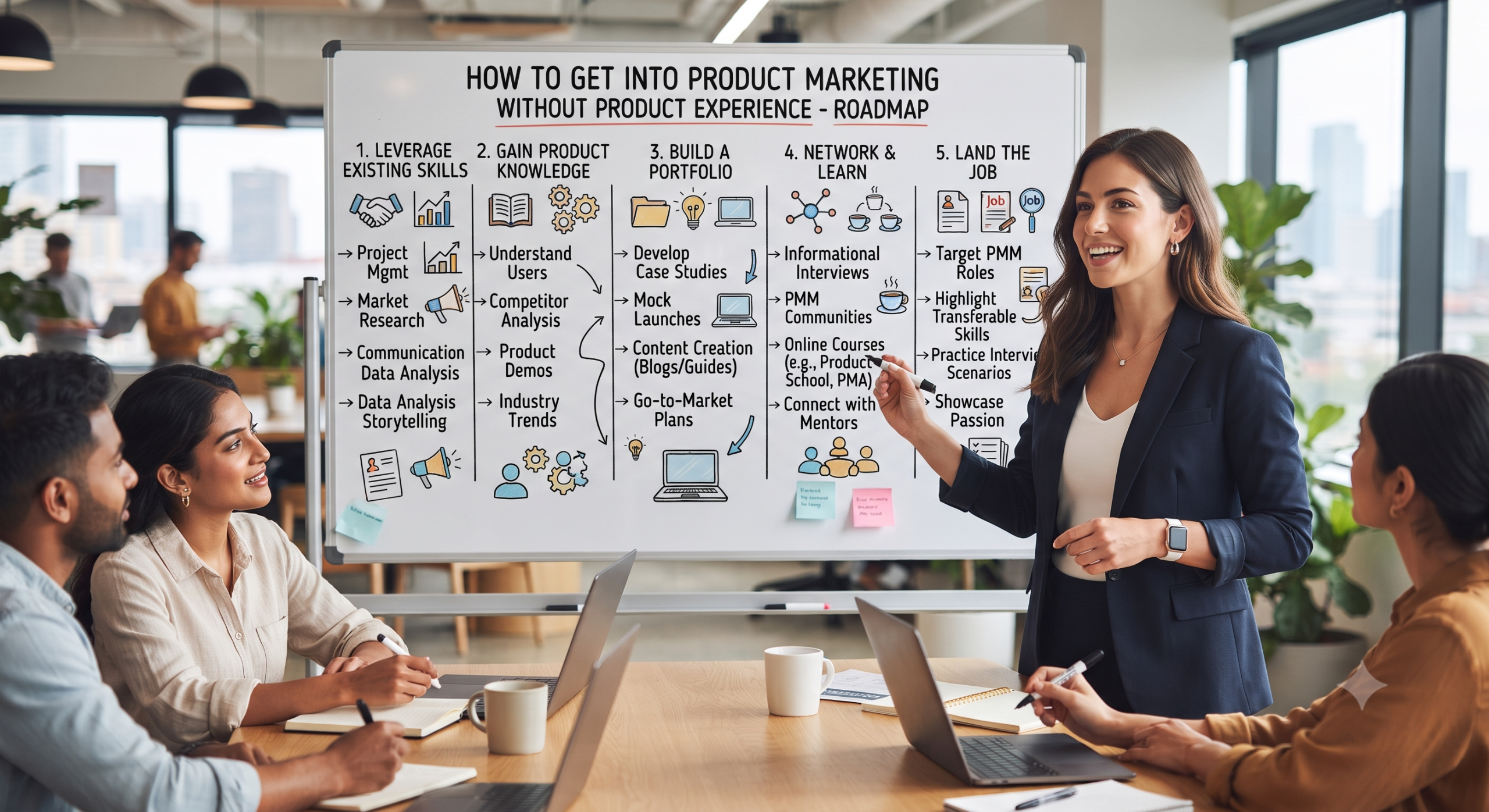
For example, create a six-month development roadmap.
Month 1: Learn product marketing fundamentals, positioning, customer research, and go-to-market strategy.
Month 2: Complete a competitor analysis and product positioning project.
Month 3: Build a detailed product marketing case study.
Month 4: Create a portfolio and begin networking with product marketing professionals.
Month 5: Apply for relevant roles and improve your resume based on job descriptions.
Month 6: Continue interviewing, networking, and developing additional portfolio projects.
At the same time, review your financial position before making a major career change. Consider:
- Monthly expenses
- Emergency savings
- Learning costs
- Certification expenses
- Expected salary range
- Potential income changes
- Remote-work expenses
- Travel or relocation costs
This approach allows you to make a career transition while maintaining financial stability.
Additionally, compare opportunities based on responsibilities, growth potential, work arrangements, location, and required skills. A best job tool, as a global job platform, can help you discover relevant roles and compare opportunities across different markets.
Conclusion
Getting into product marketing without direct product experience requires a strategic approach rather than a complete career restart. First, understand what product marketers do and identify the transferable skills you already possess. Then, build practical experience through portfolio projects, customer research, positioning exercises, and go-to-market plans.
Furthermore, collaborate with product and sales teams whenever possible. These opportunities can provide real-world experience and stronger examples for your resume.
Remote projects and global opportunities can also help you develop broader market knowledge. However, focus on documenting measurable outcomes rather than simply collecting activities.
Most importantly, build evidence of your ability. A strong portfolio, targeted resume, relevant projects, and consistent networking can demonstrate that you are prepared for product marketing work even without a previous product marketing title.
With a structured learning plan and sensible financial planning, you can gradually move from your existing career into product marketing while continuing to build valuable skills along the way.

Leave a Reply