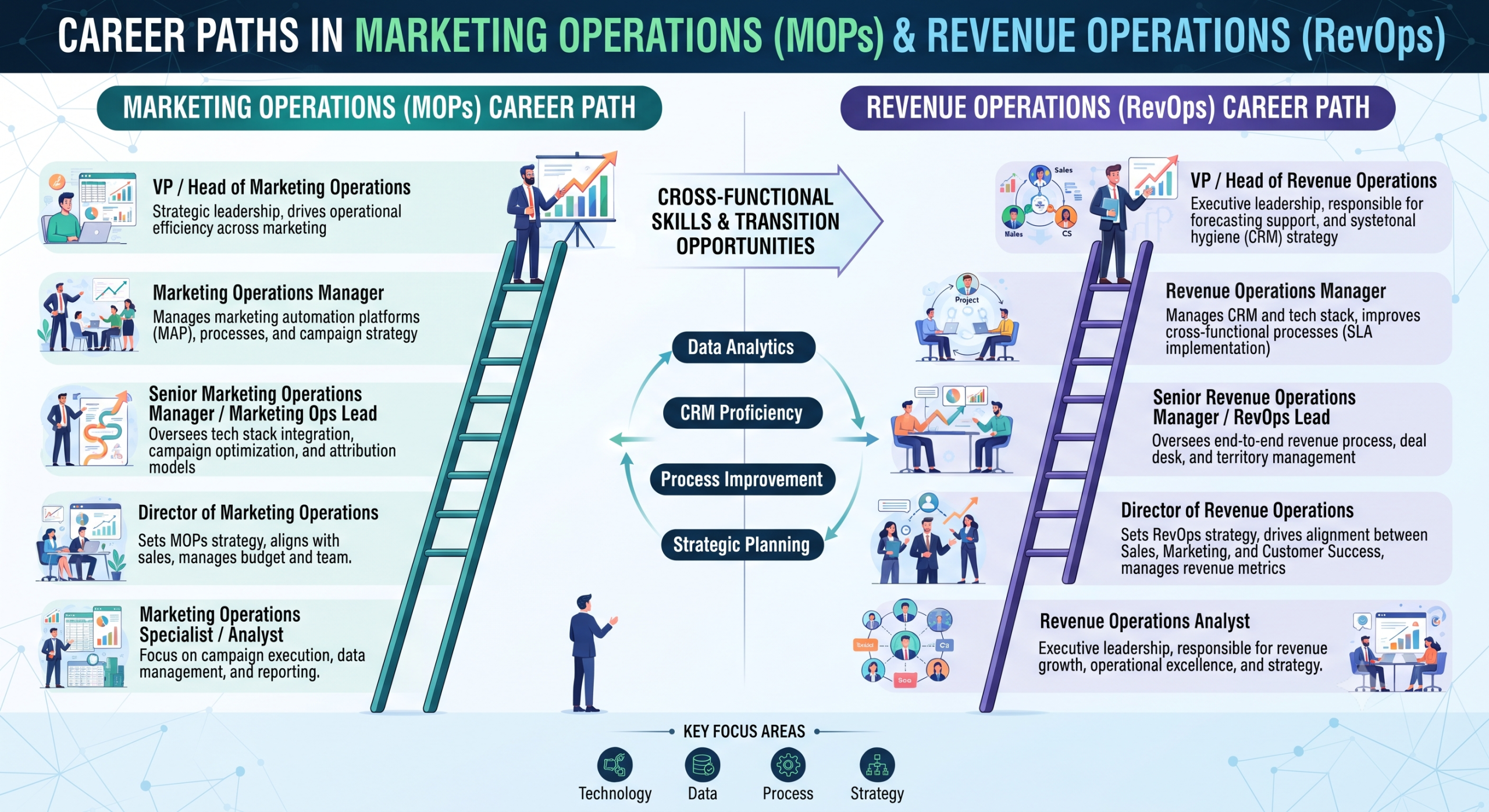
Marketing and sales teams increasingly depend on technology, data, automation, and well-defined processes to generate predictable business results. As a result, Marketing Operations and Revenue Operations have become important career areas for professionals who enjoy working with systems, analytics, and business strategy.
Unlike traditional marketing roles, these careers focus heavily on how teams operate behind the scenes. Marketing Operations professionals manage campaigns, technology, data, reporting, and workflows. Revenue Operations professionals take a broader approach by connecting marketing, sales, customer success, and revenue teams.
Therefore, professionals entering these fields can develop careers that combine technology, analytics, process management, and business operations. The roles are also increasingly compatible with remote work because many responsibilities involve digital platforms and cross-functional collaboration.
This guide explains the major career paths in Marketing Operations and Revenue Operations, the skills required, and practical ways to build a long-term career in these fields.
Understand Marketing Operations and Revenue Operations
First, it is important to understand the difference between Marketing Operations and Revenue Operations.
Marketing Operations focuses primarily on improving the systems and processes used by marketing teams. Professionals in this area may manage marketing automation platforms, campaign workflows, reporting systems, customer data, and performance dashboards.
Revenue Operations, meanwhile, has a broader business focus. RevOps teams connect marketing, sales, customer success, finance, and other revenue-related functions. Their goal is to create consistent processes and reliable data across the customer lifecycle.
Typical Marketing Operations responsibilities include:
- Managing marketing automation systems
- Building campaign workflows
- Maintaining marketing databases
- Creating performance reports
- Managing lead processes
- Supporting campaign attribution
- Improving marketing processes
- Coordinating marketing technology
Revenue Operations may involve:
- Sales and marketing alignment
- Revenue forecasting
- CRM management
- Pipeline analysis
- Process optimization
- Customer lifecycle reporting
- Data governance
- Cross-functional planning
Therefore, both career paths require strong organizational and analytical abilities. However, RevOps generally operates across more business functions.
Start With Entry-Level Marketing Operations Roles
Marketing Operations offers several entry points for professionals who are interested in technology and marketing but do not want a traditional creative marketing career.
Common entry-level positions include:
- Marketing Operations Coordinator
- Marketing Operations Specialist
- Marketing Automation Specialist
- CRM Specialist
- Campaign Operations Specialist
- Marketing Technology Coordinator
- Demand Generation Operations Specialist
At this stage, your primary goal should be to understand how marketing systems work.
For example, you may manage email campaigns, maintain contact databases, create automation workflows, or prepare campaign performance reports. Over time, these responsibilities can provide exposure to larger marketing systems and business processes.
Additionally, professionals can move into more specialized roles after gaining practical experience.
For instance, someone who enjoys data may move toward marketing analytics. Similarly, a professional interested in technology may specialize in marketing automation or CRM administration.
Build a Career in Marketing Automation and Technology
Marketing automation is one of the most technology-focused paths within Marketing Operations. Companies use automation platforms to manage email campaigns, lead nurturing, segmentation, customer journeys, and campaign workflows.
As a result, professionals who understand marketing technology can become valuable members of growth teams.
A marketing automation specialist may work on:
- Automated email sequences
- Lead scoring
- Customer segmentation
- Campaign workflows
- Form and landing page integrations
- Lead routing
- Customer journey automation
- Campaign reporting
However, technical knowledge alone is not enough. You also need to understand why a workflow exists and what business objective it supports.
For example, creating an automated email sequence is a technical task. Designing that sequence around customer behavior, lifecycle stages, and conversion goals requires broader marketing knowledge.
Therefore, learn both the technology and the business logic behind it.
You can begin by practicing with sample workflows. Create a fictional customer journey and map the actions that should happen when a user signs up, downloads content, requests information, or becomes a customer.
Move Into Marketing Analytics and Performance Operations
If you enjoy working with numbers, Marketing Analytics can provide another strong career path.
Marketing operations teams generate large amounts of data. However, collecting data is only useful when professionals can convert it into meaningful business insights.
Marketing analysts may evaluate:
- Campaign performance
- Lead conversion rates
- Customer acquisition costs
- Marketing pipeline
- Channel performance
- Conversion rates
- Customer behavior
- Return on marketing investment
For example, an analyst may discover that one marketing channel generates many leads but relatively few qualified opportunities. Meanwhile, another channel may produce fewer leads but significantly higher conversion rates.
Therefore, the analyst can help marketing leaders allocate resources more effectively.
To develop this career path, focus on spreadsheet analysis, dashboard development, data visualization, CRM reporting, and basic statistical concepts.
Furthermore, learning SQL and business intelligence tools can create additional opportunities, particularly as you progress toward senior analytical roles.
Progress Into Revenue Operations
After gaining experience in Marketing Operations, many professionals can expand into Revenue Operations.
RevOps professionals focus on the complete revenue process rather than only marketing activities. Therefore, they need to understand how different teams interact with customers.
A Revenue Operations professional may work on:
- CRM processes
- Lead-to-customer workflows
- Sales pipeline management
- Revenue forecasting
- Customer lifecycle reporting
- Territory planning
- Sales operations
- Marketing and sales alignment
- Customer success processes
For example, imagine that marketing generates qualified leads, but sales representatives do not receive those leads quickly. A RevOps professional may investigate the workflow, identify the problem, and redesign the process.
Similarly, if sales forecasts are inconsistent because teams use different definitions of qualified opportunities, RevOps can establish common processes and reporting standards.
As a result, RevOps requires both analytical thinking and strong communication.
Professionals in these roles must understand data while also working effectively with stakeholders from different departments.
Develop the Skills Required for Long-Term Growth
Whether you choose Marketing Operations or Revenue Operations, certain skills become increasingly important as you progress.
Start with core technical abilities:
- CRM systems
- Marketing automation
- Spreadsheet analysis
- Data visualization
- Reporting
- Workflow automation
- Database management
- Basic analytics
Next, develop business skills:
- Process improvement
- Project management
- Strategic planning
- Communication
- Problem-solving
- Stakeholder management
- Business analysis
In addition, learn how revenue teams measure performance.
Understand concepts such as:
- Customer acquisition cost
- Customer lifetime value
- Conversion rate
- Pipeline velocity
- Revenue growth
- Churn
- Retention
- Marketing contribution to revenue
The combination of technical and commercial knowledge can make your profile stronger.
For example, someone who knows how to build a CRM report is useful. However, someone who can build the report and explain how its insights can improve pipeline performance provides greater business value.
Use Remote Work and Global Opportunities to Expand Your Career
Marketing Operations and Revenue Operations are well suited to remote and hybrid work because many responsibilities can be performed through cloud-based systems.
Remote professionals can collaborate with marketing, sales, finance, and customer success teams across different locations. Therefore, these careers can provide opportunities to work with international organizations without always requiring relocation.
Remote work also creates opportunities to gain experience through distributed projects. For example, you can participate in:
- Global campaign operations
- CRM implementation projects
- International customer research
- Remote reporting projects
- Marketing automation
- Revenue dashboards
- Cross-functional process improvements
Travel testing can also be relevant when companies operate across multiple regions. For example, professionals supporting travel technology, hospitality, or location-based services can evaluate customer journeys across different markets.
However, testing should be structured. Document the customer experience, identify process problems, and connect your findings to measurable business improvements.
When searching for suitable positions, a best job tool, which is a global job platform, can help you explore Marketing Operations and Revenue Operations opportunities across different locations and work arrangements.
Additionally, review job descriptions carefully. Similar responsibilities can appear under titles such as Marketing Operations Analyst, Revenue Operations Analyst, GTM Operations Specialist, Sales Operations Analyst, Marketing Technology Specialist, and RevOps Manager.
Plan Your Career Progression and Financial Goals
Finally, create a career roadmap instead of focusing only on your next job title.
A possible progression could look like this:
Entry level:
Marketing Operations Coordinator or Operations Specialist
Early career:
Marketing Operations Specialist, Marketing Automation Specialist, or Operations Analyst
Mid-level:
Marketing Operations Manager, Revenue Operations Analyst, or Revenue Operations Manager
Senior level:
Senior RevOps Manager, Head of Revenue Operations, or Operations Director
However, career progression varies between organizations. Therefore, focus on developing capabilities rather than following one fixed title sequence.
At the same time, create a financial plan for your career development.
Consider:
- Training expenses
- Software certifications
- Professional courses
- Emergency savings
- Expected salary changes
- Remote-work expenses
- Relocation costs
- Long-term savings
For example, if you plan to move from Marketing Operations into RevOps, you may need to invest time in CRM administration, analytics, forecasting, and business strategy.
Therefore, include learning expenses and time commitments in your financial planning.
A best job tool, as a global job platform, can also help you research different opportunities and identify roles that match your current skills and future career goals.
Conclusion
Marketing Operations and Revenue Operations offer career paths for professionals who enjoy combining technology, analytics, marketing, and business strategy. Although the roles work behind the scenes, their impact on business performance can be significant.
First, professionals can enter through Marketing Operations, marketing automation, CRM, or analytics roles. Then, with experience, they can move into specialized positions or expand toward Revenue Operations.
Furthermore, developing both technical and business skills can create more opportunities for career progression. Learning CRM systems, automation, analytics, reporting, process improvement, and revenue metrics can help professionals become more valuable to growing organizations.
Remote work can also expand access to international opportunities. However, professionals should focus on building measurable experience rather than simply collecting software knowledge.
Ultimately, the strongest career strategy is to understand how systems, data, people, and revenue processes connect. By developing those capabilities gradually, professionals can build sustainable careers across Marketing Operations and Revenue Operations while maintaining clear productivity and financial goals.



Leave a Reply