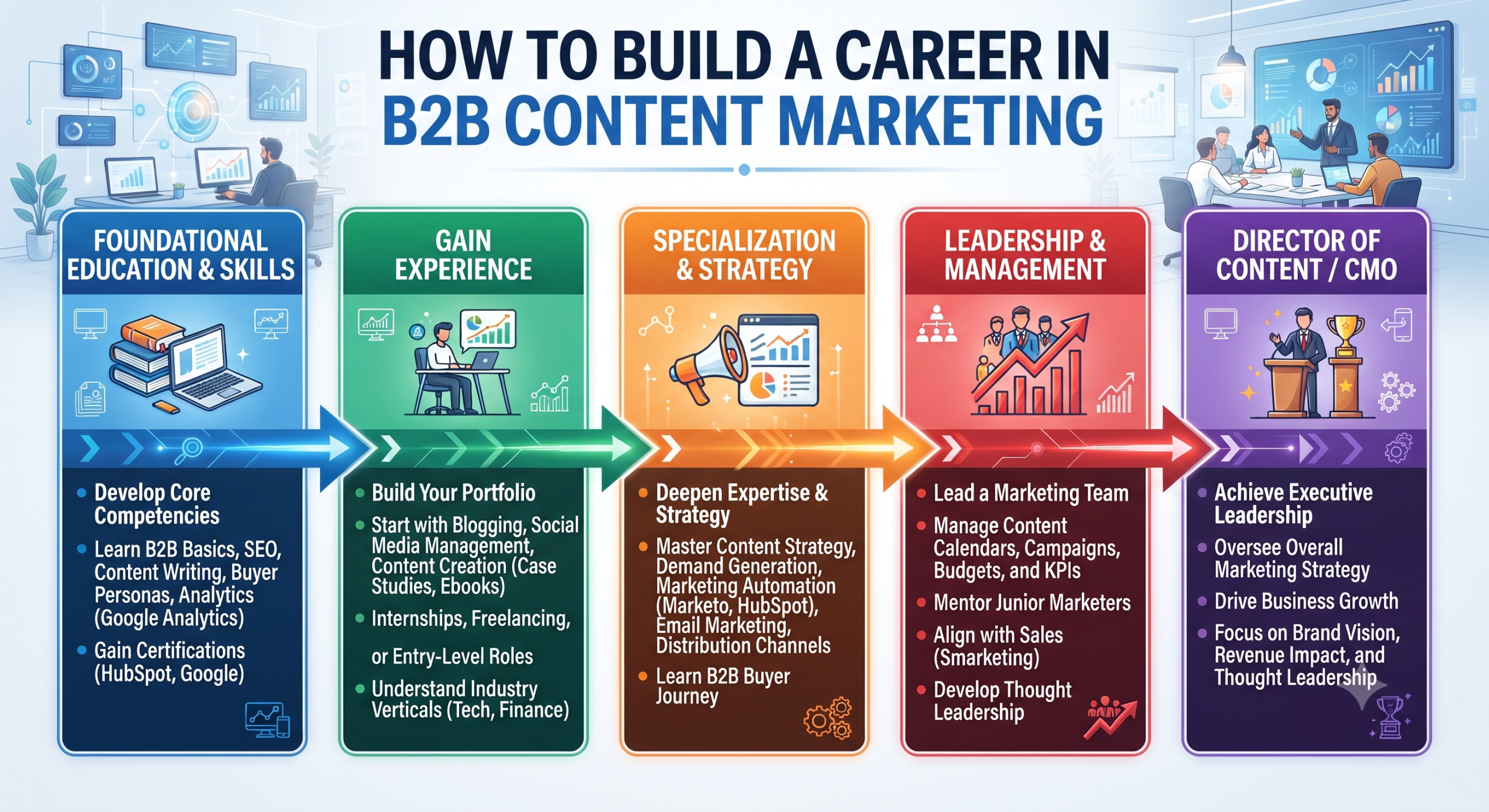
B2B content marketing has become an important part of how companies attract prospects, build credibility, and support sales. Unlike consumer marketing, B2B content often involves longer buying cycles, multiple decision-makers, technical products, and highly specific business problems. Therefore, professionals working in this field need more than strong writing skills. They also need research, strategic thinking, audience analysis, and business knowledge.
As companies continue investing in digital channels, skilled B2B content marketers can find opportunities across technology, finance, consulting, healthcare, SaaS, professional services, and other industries. Moreover, many B2B content roles can be performed remotely, making this career path accessible to professionals working with international teams.
The good news is that you do not need to follow one specific career path to enter B2B content marketing. Instead, you can build relevant skills through writing, research, portfolio projects, industry knowledge, and measurable campaign experience. This guide explains how to develop those skills and create a sustainable career in B2B content marketing.
Understand How B2B Content Marketing Works
First, understand what makes B2B content different from general content marketing. B2B audiences usually consume content to solve business problems, evaluate solutions, reduce risk, or support purchasing decisions.
Therefore, B2B content often focuses on practical information rather than purely promotional messaging.
Common B2B content formats include:
- Industry reports
- White papers
- Case studies
- Blog articles
- Research reports
- Email newsletters
- LinkedIn content
- Product guides
- Webinars
- E-books
- Sales enablement content
For example, a B2B software company might publish an article explaining how businesses can improve workflow efficiency. Later, the same company may use a case study to show how an existing customer achieved measurable results.
As a result, B2B content marketers need to understand the entire customer journey. Awareness content may educate potential buyers, while consideration content can help them compare solutions. Finally, decision-stage content can support sales conversations.
Understanding this journey should be the foundation of your career development.
Develop Strong Research and Writing Skills
Next, focus on research. Good B2B content depends on accurate information and a clear understanding of the target audience.
Before writing an article, research:
- Customer problems
- Industry trends
- Competitor content
- Search behavior
- Customer questions
- Expert opinions
- Relevant statistics
- Product use cases
For instance, if you are writing about cybersecurity for business leaders, you need to understand both the technical subject and the concerns of the people responsible for purchasing cybersecurity solutions.
Therefore, avoid writing content based only on general online information. Instead, look for reliable industry reports, expert interviews, customer insights, and company data.
Writing ability is equally important. However, B2B writing does not necessarily mean using complicated language. In fact, clear and direct writing is often more useful because business readers have limited time.
Practice explaining complex topics in simple terms. Additionally, learn how to structure articles with strong introductions, descriptive headings, short paragraphs, examples, and actionable recommendations.
Learn SEO and Search-Focused Content Strategy
SEO is another important skill for B2B content marketers because businesses often use search engines to research products, services, and industry problems.
However, effective B2B SEO is not simply about inserting keywords into articles. Instead, it requires understanding search intent.
For example, someone searching for “CRM software comparison” probably has a different intent from someone searching for “what is CRM.”
Therefore, identify the purpose behind a search query before creating content.
A practical B2B SEO process includes:
- Research relevant keywords.
- Identify search intent.
- Analyze competing content.
- Create a useful content outline.
- Use keywords naturally.
- Add relevant examples and data.
- Improve internal linking.
- Optimize titles and descriptions.
- Review content performance.
- Update successful articles regularly.
Furthermore, learn how content contributes to the sales funnel. High-traffic content is useful, but traffic alone does not necessarily create business value.
For example, a smaller article that attracts highly relevant decision-makers may generate more qualified leads than a broad article with thousands of visitors.
Consequently, B2B content marketers should understand both SEO metrics and business outcomes.
Build Industry and Business Knowledge
B2B content becomes much stronger when the writer understands the industry. Therefore, choose one or two industries where you can develop deeper knowledge.
Possible areas include:
- SaaS
- FinTech
- Healthcare
- Cybersecurity
- Logistics
- Manufacturing
- Human resources
- Professional services
- E-commerce technology
- Business consulting
You do not need to become an industry expert immediately. Instead, create a structured learning routine.
For example, spend time each week reading industry publications, company reports, expert interviews, and customer discussions. Then, create short summaries of what you learn.
Additionally, study how companies in your chosen industry make money. Understand their customers, products, competitors, sales cycles, and major challenges.
This business knowledge will improve your content because you will understand why a particular topic matters to the audience.
For instance, a logistics company may care about delivery efficiency, inventory visibility, cost reduction, and operational reliability. Therefore, content around those business outcomes will usually be more useful than generic logistics advice.
Create a B2B Content Portfolio
If you want to enter B2B content marketing, build a portfolio that demonstrates your ability to create business-focused content.
You do not need dozens of samples. Instead, create four to six strong pieces that demonstrate different skills.
Your portfolio could include:
- SEO-focused B2B article
- Industry research article
- Customer case study
- LinkedIn thought-leadership post
- Product comparison article
- Lead-generation landing page
- Email campaign
- White paper outline
For each project, explain the objective and intended audience.
For example, create a fictional case study for a SaaS company. Explain the customer’s problem, the solution, the implementation process, and measurable results.
Similarly, create an SEO article targeting a specific business audience. Include the keyword strategy, search intent, content structure, and suggested conversion point.
As a result, employers can see that you understand content as a business tool rather than simply a writing exercise.
If you already have professional experience, update older work samples to emphasize business outcomes. For example, mention increased organic traffic, engagement, leads, downloads, email subscriptions, or conversions when reliable data is available.
Gain Experience Through Remote and Cross-Functional Projects
B2B content marketing frequently involves collaboration with sales, product, customer success, design, SEO, and leadership teams. Therefore, learning to work cross-functionally is essential.
If you already have a job, volunteer for projects involving:
- Product launches
- Customer case studies
- Sales presentations
- Industry reports
- Email campaigns
- Website content
- Webinar promotion
- Product documentation
- Customer interviews
For example, work with the sales team to identify common customer questions. Then, turn those questions into useful articles or downloadable guides.
Similarly, speak with customer success teams to identify recurring customer problems. These insights can become highly relevant content topics.
Remote work can provide additional opportunities because B2B teams often collaborate through digital platforms. You can work with colleagues in different locations, conduct virtual interviews, and contribute to international content projects.
Travel testing can also be useful when working with industries such as travel technology, hospitality, logistics, or international services. For example, testing a travel platform across different destinations can reveal customer experience issues that could become valuable research-based content.
However, always document the business purpose of your research. Explain what you tested, what you learned, and how the information could improve customer communication.
When looking for relevant positions, a best job tool, which is a global job platform, can help you explore B2B content marketing opportunities across different locations and work arrangements.
Build a Long-Term Career and Measure Business Impact
Finally, think beyond your first B2B content role. Content marketing can lead to several career directions.
You could progress into roles such as:
- B2B Content Writer
- Content Marketing Specialist
- SEO Content Strategist
- Content Marketing Manager
- Demand Generation Content Manager
- Content Strategist
- Product Marketing Content Specialist
- Content Director
- Head of Content
However, career progression usually depends on your ability to connect content with business results.
Therefore, learn how to measure:
- Organic traffic
- Qualified leads
- Conversion rates
- Engagement
- Email subscriptions
- Content-assisted opportunities
- Pipeline contribution
- Customer acquisition
- Content conversion rates
For example, if an article generates 10,000 visits but no qualified leads, its business value may be different from an article that generates 2,000 visits and several sales opportunities.
As a result, experienced B2B content marketers increasingly combine creativity with analytics.
You should also plan your professional development financially. Consider the cost of SEO tools, courses, certifications, conferences, writing software, and other resources. At the same time, maintain an emergency fund and evaluate potential salary changes when moving between roles.
A best job tool, as a global job platform, can help you research relevant openings, compare job requirements, and identify opportunities that match your developing skills.
Conclusion
Building a career in B2B content marketing requires more than becoming a better writer. First, you need to understand how businesses buy products and services. Then, develop research, SEO, writing, industry knowledge, and content strategy skills.
Furthermore, create a focused portfolio that demonstrates your ability to solve business communication problems. Practical projects can be especially valuable when you are changing careers or have limited professional B2B experience.
Cross-functional and remote projects can also help you understand how content supports sales, product, and customer success teams. Meanwhile, developing knowledge of analytics allows you to connect content activities with measurable business outcomes.
Most importantly, treat B2B content as a business function rather than simply a publishing activity. When you can research an audience, identify a meaningful problem, create useful content, and measure its impact, you become more valuable to B2B organizations.
With consistent skill development, practical experience, and a focused portfolio, you can build a long-term career in B2B content marketing and eventually move into strategy, demand generation, product marketing, or senior content leadership.



Leave a Reply