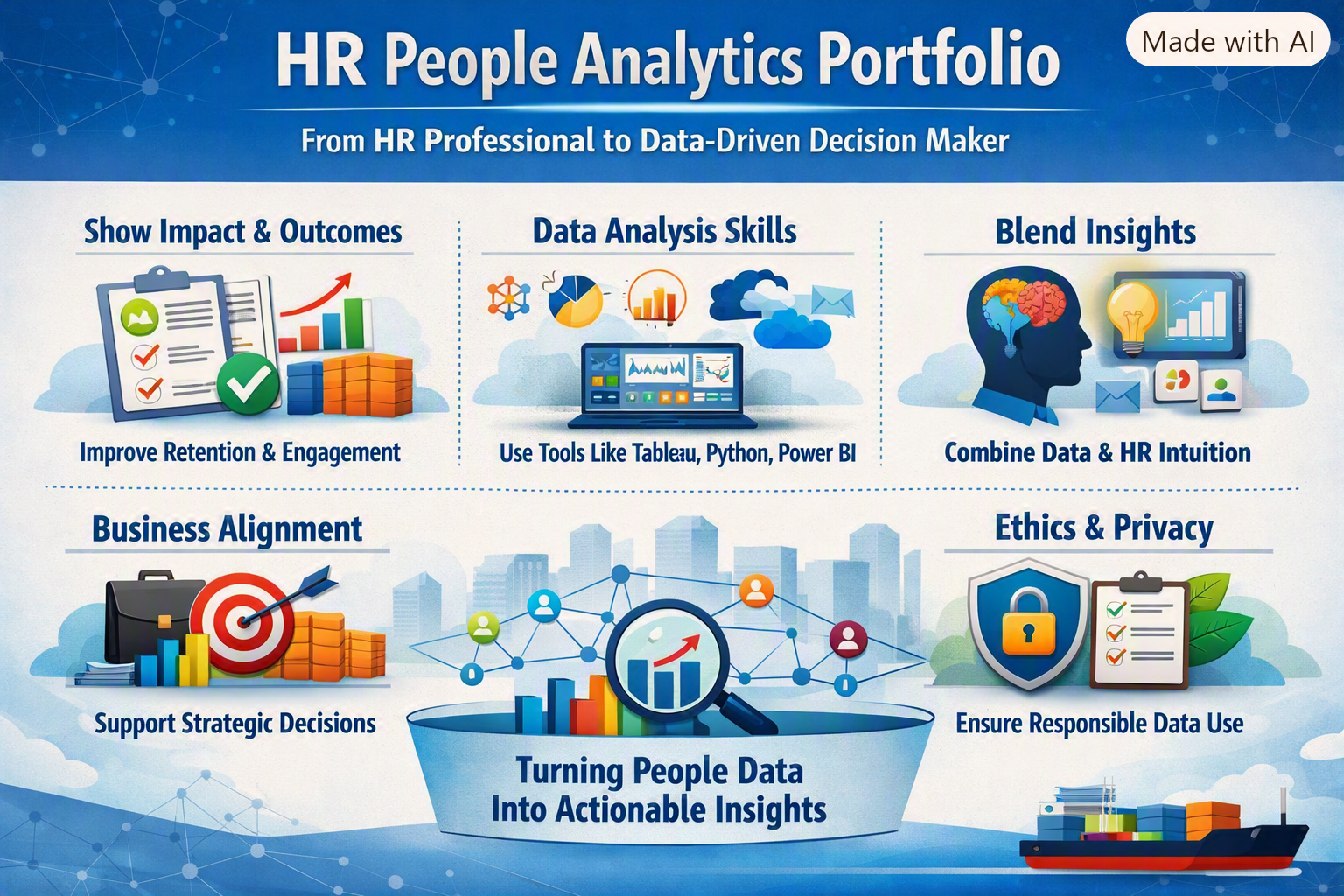
Introduction: Portfolio Ideas for HR
HR professionals are currently facing a paradigm shift – the skills of the future now include digital literacy and the ability to work with data. Companies are actively collecting and analyzing employee data to optimize their people functions, ranging from hiring and retention to workforce planning and performance management. This creates exciting opportunities for people analytics-focused professionals who enjoy working with numbers and detecting patterns.
If you are planning to make the transition from traditional HR to people analytics, it is important to design a portfolio that will demonstrate your business-oriented data analysis skills to potential employers.
The following portfolio ideas for HR professionals looking to move into people analytics can serve as inspiration for creating a compelling and comprehensive showcase of your abilities.
Portfolio Ideas for HR Professionals Looking To Move Into People Analytics Essay
1. People analytics: employee attrition analysis
One of the most common use cases of people analytics is predicting employee turnover. Create an itemized list of things that cause employees to leave the company (use a sample data set) and visualize the insights in the form of charts.
For example, you can address the following questions:
- What departments have the highest attrition rates?
- Is there a correlation between an employee’s salary and the likelihood to leave?
- Are new hires more likely to be dissatisfied with their jobs?
- Does working overtime increase the chances of an employee quitting?
2. People analytics: recruitment dashboard
Another compelling use case for your people analytics portfolio is designing a recruitment dashboard. It can include such metrics as
number of applicants, interview to selection ratio, time-to-hire, cost per hire, offer acceptance rate, and top sources of hire.
You can use Excel, Power BI, or Tableau to create the dashboard and display your analytical and visualizing skills. Make sure to add explanations as to why certain recruitment metrics are important.
3. People analytics: employee engagement analysis
Employee engagement surveys are a rich source of data that can help HR professionals identify the root causes of attrition and other issues. For your people analytics portfolio, you can take a sample survey and analyze the drivers of employee engagement. Make sure to address such questions as
- are employees satisfied with the management?
- do they feel their workloads are appropriate?
- is the company’s feedback culture effective?
- is employee recognition sufficient?
- is there room for improvement in terms of career development?
Once you identify areas of concern, you can recommend concrete recruitment or people analytics-driven initiatives to improve the situation.
4. People analytics: salary analysis
Analyzing salary data can be a great way to demonstrate your people analytics skills while also learning valuable lessons about the labor market. You can either use real-world data (with sensitive information anonymized) or design a fictional data set and work with it. Some interesting insights to include are salary distribution per department and job level, and average salaries for employees with comparable work experience.
Make sure to display your findings in the form of easy-to-read visualizations and avoid unsubstantiated claims about the analyzed data sets.
5. People analytics: workforce planning
For this item in your people analytics portfolio, you can build a simple workforce planning model. For example, you can calculate how many employees a company will need in 3 years given that it plans to grow its revenues by 15% per year. You can use a simple Excel model, populate it with relevant data (current headcount, turnover rates), and make a forecast. This is a great way to demonstrate business acumen while also displaying your people analytics skills.
6. People analytics: diversity dashboard
A diversity dashboard is another compelling option for building a people analytics portfolio. You can either use real-world data (with sensitive information anonymized) or design a fictional dashboard. The goal is to visualize pertinent information such as workforce distribution per diversity category, number of promotions by gender, and similar statistics. The key is to remember that the people analytics professional is not an ethicist, so you want to avoid jumping to unsubstantiated conclusions about the causes of the observed trends.
Conclusion: Portfolio Ideas for HR
Transitioning from traditional HR to people analytics demands a portfolio that demonstrates both analytical rigor and human insight. The most successful professionals bridge the gap between data storytelling and strategic workforce impact.
Shifting from traditional HR into people analytics requires more than technical skill — it demands a portfolio that demonstrates the ability to turn workforce data into actionable insights. The strongest portfolios show how HR professionals evolve into strategic partners who use analytics to shape organizational outcomes.

Leave a Reply