Introduction: Supply Chain Professionals
Job seekers in the supply chain field looking to transition into a career in consulting may find themselves in a difficult position. While their experience in the field provides a great foundation for the job, consulting firms are looking for candidates who can demonstrate their ability to analyze business problems and propose profitable solutions.
A portfolio can serve as a great tool to demonstrate these skills before an interview. And instead of simply listing out their responsibilities as a supply chain professional on a resume, job seekers can use the portfolio to demonstrate how they would apply their knowledge and skills in a business setting.
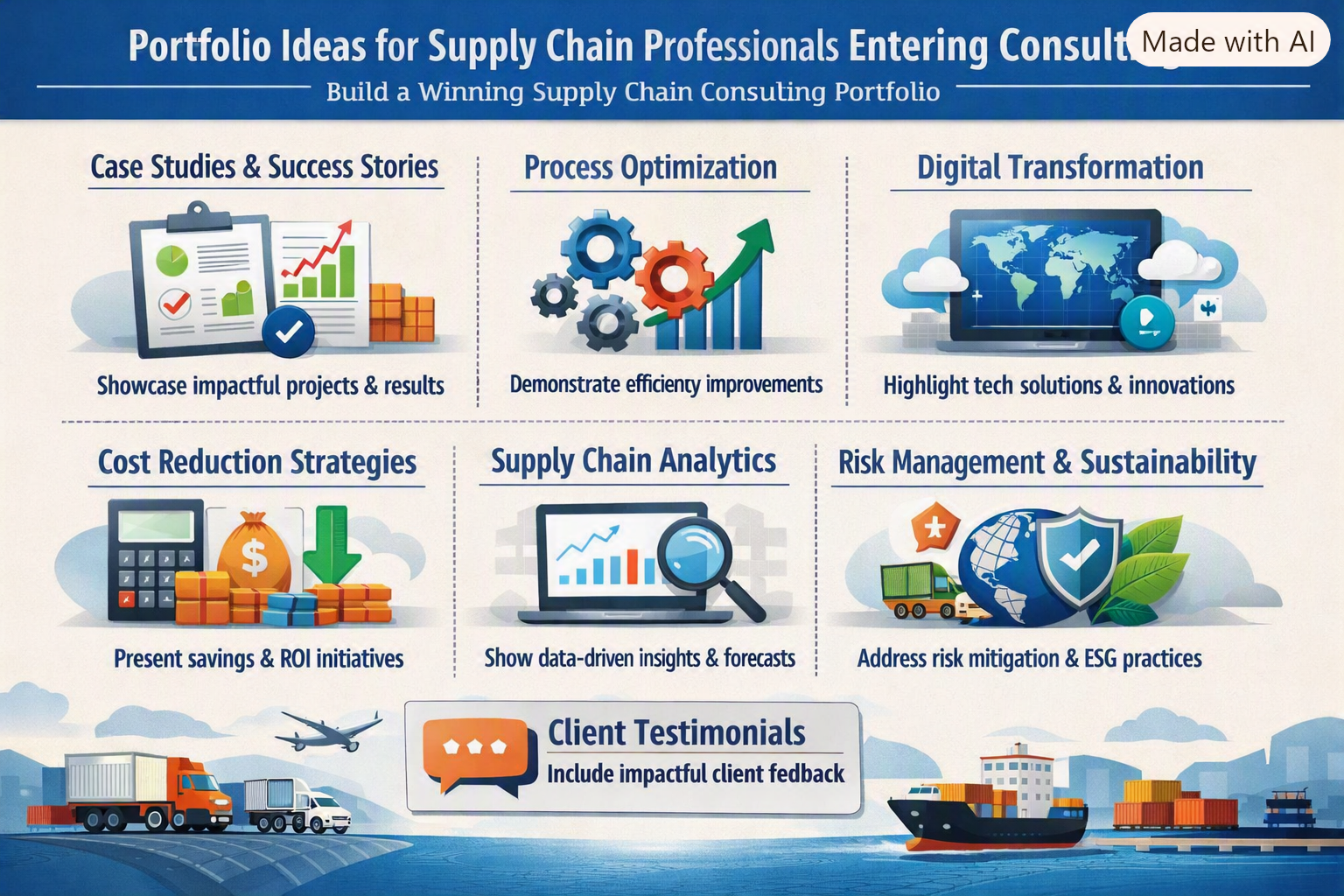
Portfolio ideas For supply chain professionals entering consulting can include a variety of consulting projects demonstrating the candidate’s ability to apply their supply chain expertise in a business context.
Portfolio Ideas for Supply Chain Professionals Entering Consulting
1. Supply Chain Cost Reduction Project
A great portfolio project for supply chain professionals entering consulting involves analyzing a business process and finding ways to reduce costs.
An ideal candidate can select a fictional or real-life company and identify opportunities for cost reduction. The candidate would then perform research and calculations to support their findings and recommend cost-saving measures.
The project can focus on any business process, ranging from transportation and warehousing to packaging and procurement. Moreover, the candidate is recommended to not only identify the final recommendations but also explain their findings and how they were determined.
2. Inventory Optimization Case Study
Inventory management is an essential component of any supply chain, and there are plenty of opportunities for consultants to help businesses optimize their inventory management processes.
A sample case study can involve creating an illustrative example of a company that wants to reduce its inventory costs while still maintaining adequate inventory levels to meet demand. The candidate would then determine the relevant variables and analyze the data to identify opportunities for cost reduction.
The candidate can also group products based on certain criteria, such as demand and business criticality, and make recommendations for each category. The project demonstrates the candidate’s ability to apply analytical skills and business sense.
3. Procurement Strategy Analysis
Another great project for a supply chain consulting portfolio is to analyze a company’s procurement needs and make recommendations on how the company can reduce costs and improve its procurement strategy.
The candidate should first describe the company’s procurement requirements and analyze the current procurement strategy. They would then identify the most attractive suppliers based on specific criteria and make recommendations.
To demonstrate their consulting and analytical skills, an ideal candidate would prepare an illustrative financial comparison of the available options and conclude with their recommendation.
4. Logistics Network Design
Consulting projects often involve optimizing a company’s logistics networks. A logistics project can be a great addition to a consulting portfolio as it demonstrates the candidate’s problem-solving, quantitative, and graphical analysis skills.
The candidate can design a fictional company with multiple warehouses, suppliers, and customers and analyze its logistics network to identify areas for improvement. There are many opportunities for optimization, such as adding new warehouses, optimizing delivery routes, consolidating shipments, and many others.
The candidate can use calculations and graphical analysis to support their recommendations and improve the efficiency of the supply chain network.
5. Supply Chain Risk Assessment
Every company is vulnerable to a wide range of supply chain risks, such as supplier failure, transportation delays, raw material shortages, and demand fluctuations. A supply chain risk assessment project would involve identifying the key risks facing the company and developing risk mitigation strategies.
An ideal candidate for a supply chain consulting portfolio would first identify the key risks and rate them according to their potential impact and likelihood. They would then create a simple risk matrix and develop risk mitigation strategies for each of the identified risks.
6. Business Dashboard Creation
One of the main skills required of consultants is the ability to analyze complex data sets and identify trends and patterns that can help business leaders make better business decisions. Creating a business dashboard is a great way to demonstrate these skills in a portfolio.
The candidate would need to select an appropriate tool, such as Excel, Power BI, or another software, and create a dashboard that displays relevant supply chain statistics, such as inventory turnover rates, delivery performance, supplier performance, transportation costs, and order fulfillment rates.
Rather than trying to display as much information as possible, the candidate should focus on a particular aspect of supply chain management and display relevant metrics that can help the business make better decisions. For example, rather than simply displaying inventory levels, the candidate can highlight inventory issues and recommend operating procedures that would help resolve the problems.
Conclusion: Supply Chain Professionals
Consulting employers are looking for candidates who demonstrate analytical thinking, problem-solving skills, and business acumen. A portfolio can be a great way for supply chain job seekers to demonstrate these skills by replicating a real-world consulting project.
The goal of the portfolio is to demonstrate that the candidate can understand a business problem, analyze it, and come up with a set of profitable recommendations. Using a variety of projects, such as cost reduction analysis, inventory optimization, procurement, logistics design, and risk assessment, the candidate can demonstrate their analytical and consulting skills in a variety of business settings.
To explore more such blogs, you can visit the Best Job Tool.




Leave a Reply